Sabtu, 03 November 2012

Church Funding

The Lindberg Church of Christ in Anderson, Indiana came up with a different way to handle a construction and renovation loan. Seizing on a plan to pay back the loan, they took a less conventional route.
church leaders took out life insurance policies on 11 of their older members to cover construction and renovation projects.
Herald Bulletin, "Church failed financial plan"

However noble their cause, the plan had a few hitches.
the plan fell through when there was no market to sell the life insurance policies and “the insureds continued to live,” 
Terribly inconsiderate of their parishioners, don't you think?

Jumat, 02 November 2012

E&Oxchanges

Because we already know just how efficient government bureaucracies are (*cough*), the latest anticipated problem with the ObamaTax Exchanges should come as no surprise:

"The [ObamaTax] could create new opportunities for employers to get health insurers to compete for their business -- and new opportunities for health insurance exchanges to mess up enrollment."

Think about it: these are the folks who run the Post Office and the DMV, and they're going to be in charge of making sure that employees are properly enrolled when employers begin to shed group health plans.

This is pure wishful thinking:

"[B]rokers have to think just as hard about how the enrollment process will work when they are placing business through an exchange as when they are dealing with one of the "back end" companies that handles enrollment data or send enrollment data directly to insurers"

Um, no, they're not, because no professional agent is going to touch an Exchange-based product with a 10 foot Czech. And those dumb enough to go that route have bigger problems than Errors and Omissions coverage.

And woe to the employer that thinks going through an Exchange is a good idea:

"An enrollment system may greatly increase the employer's risk ... by letting employees sign up for coverage they are not eligible to buy."

Why would any reasonably intelligent employer even bother? Much more cost effective to delete the group plan and take the (nominal) fine tax hit. After all, choosing to use an Exchange means that the employer is trusting a government bureauweenie to get things right and if they don't, well, good luck holding them accountable.

But hey, it's a Brave New World.

Kamis, 01 November 2012

Just Another IRS Form

Filed your 2014 taxes yet? No problem. You have time. They are not due for another 27 months or so.

Included in your packet will be a new form to be filed by almost everyone. There are a few groups given a free pass on the Obamacare mandate. They include:

Certain religious groups such as Amish, Scientologists and Muslims
American Indians
Non-U.S. citizens

So what kind of information are you required to share with the IRS?

Every January, health insurance companies across America will send out tax documents to each insured individual.  This tax document—a copy of which will be furnished to the IRS—must contain sufficient information for taxpayers to prove that they purchased qualifying health insurance under Obamacare.
This new tax information document must, at a minimum, contain: the name and health insurance identification number of the taxpayer; the name and tax identification number of the health insurance company; the number of months the taxpayer was covered by this insurance plan; and whether or not the plan was purchased in one of Obamacare’s “exchanges.”

ATR.org, "Obamacare Tax Form"


Kinda makes you want to contact Tom Cruise and become a Conehead doesn't it?


FrankenHealth

This has nothing to do with Al Franken. Rather, FrankenHealth is a take off on Mary Shelley's monster (Frankenstein).

What is FrankenHealth?

Obamacare on steroids.

Seems the folks who saved the auto industry, bailed out banks with Chinese dollars and gave us flaming electric cars now want to take health insurance to a whole new level.
The Obama administration will soon take on a new role as the sponsor of at least two nationwide health insuranceplans to be operated under contract with the federal government and offered to consumers in every state.
These multistate plans were included in President Obama’s health care lawas a substitute for a pure government-run health insurance program — the public option sought by many liberal Democrats and reviled by Republicans. Supporters of the national plans say they will increase competition in state health insurance markets, many of which are dominated by a handful of companies.
NY Times, "US to sponsor health insurance"

For those too young to remember, private health insurance carriers offered health insurance to seniors before there was Medicare. Once the government assumed the role as primary insurer the carriers withdrew from that market.

If you are 65 or older, living in this country and want health insurance you get it via an employer group health insurance plan or from the government (Medicare).

This idea of inducing competition to bring down prices has a nice ring to it but the truth is, private industry cannot compete with the government unless they want to go bankrupt.


Of course the U.S. is already bankrupt so what is another gazillion dollars of added debt?
The national plans will compete directly with other private insurers and may have some significant advantages, including a federal seal of approval. Premiums and benefits for the multistate insurance plans will be negotiated by the United States Office of Personnel Management, the agency that arranges health benefits for federal employees.
Wonder what a federal seal of approval looks like?
No one knows how many people will sign up for the government-sponsored plans. In preparing cost estimates, the Obama administration told insurers to assume that each national plan would have 750,000 people enrolled in the first year.
These are the same folks that estimated upwards of 375,000 would enroll in PCIP.

At last count I believe they finally hit about 80,000 or so.

Of course they also keep moving the goalposts on the actual cost of Obamacare and PCIP is a money hole.
Under the Un-Affordable Care Act, at least one of the nationwide plans must be offered by a nonprofit entity. Insurance experts see an obvious candidate for that role: the Government Employees Health Association
Wonder if we can get some financials on how well that plan is working?

But the FEHB is not truly a national plan, but rather different plans in each state that are administered by approved carriers offering plans that must comply with state mandates. 

Somehow I don't think FrankenHealth will have to follow the same rules.

ObamaTax legal update

Early last month, we noted Liberty University's pending ObamaTax lawsuit challenging the Employer Mandate. Today comes word that the Justice Department apparently has no objections to the lawsuit going forward [ed: I'm not a lawyer - and I didn't stay in a Holiday Inn Express last night - but who cares if the DoJ objects?]:

"In a brief filed with the Supreme Court late Wednesday, the Justice Department said the court should clear the way for a possible new hearing in the lawsuit filed by Liberty University."

It's still a long way from a "done deal" but at least there's progress.

LTCi November

November's been designated as national Long-Term Care Awareness Month. We've blogged on Long-Term Care insurance (LTCi) often here; my favorite post on the subject (and one I send to pretty much every prospective LTCi client) is this one from LTCi guru Herman Bruns.

Another LTCi expert is Christine van Breukelen, who alerts us to these "fun" facts:
■ Most long-term care is received at home; not in a nursing home.  In fact, 43% of long-term care insurance claim benefits paid to individuals covered home care (and only 24% paid for nursing home care.)

■ One of the significant ways to save on long-term care insurance protection is to take advantage of available discounts.  People in good health can save.  You can lock in these savings even when your health changes.  Less than half (44%) of people between 50 and 59 qualify though and that percentage declines at older ages.  Why not see if you qualify.

■ Married couples can save on long-term care insurance, sometimes even when only one person is protected.  And with new "shared care" options, two people can actually share each other's coverage.   Less money … more benefit … worth considering.
And Chris adds: There's a great saying; Failure To Plan is a Plan For Failure.  Your first step should be getting the information you need to protect yourself, your family and your loved ones.

Helpful ObamaTax recap

Amelia at Nerd Wallet has a great post neatly summarizing and explaining key fallacies of the ObamaTax.

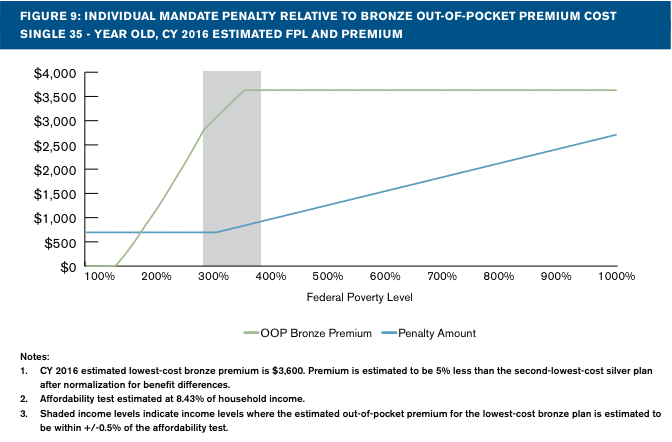
I especially liked this graph, which underscores a point we've been making for a long time (that for most folks, paying the penalty and buying coverage only when it's needed will be the most cost-effective strategy):

[click graph to embiggen]

Do check it out.